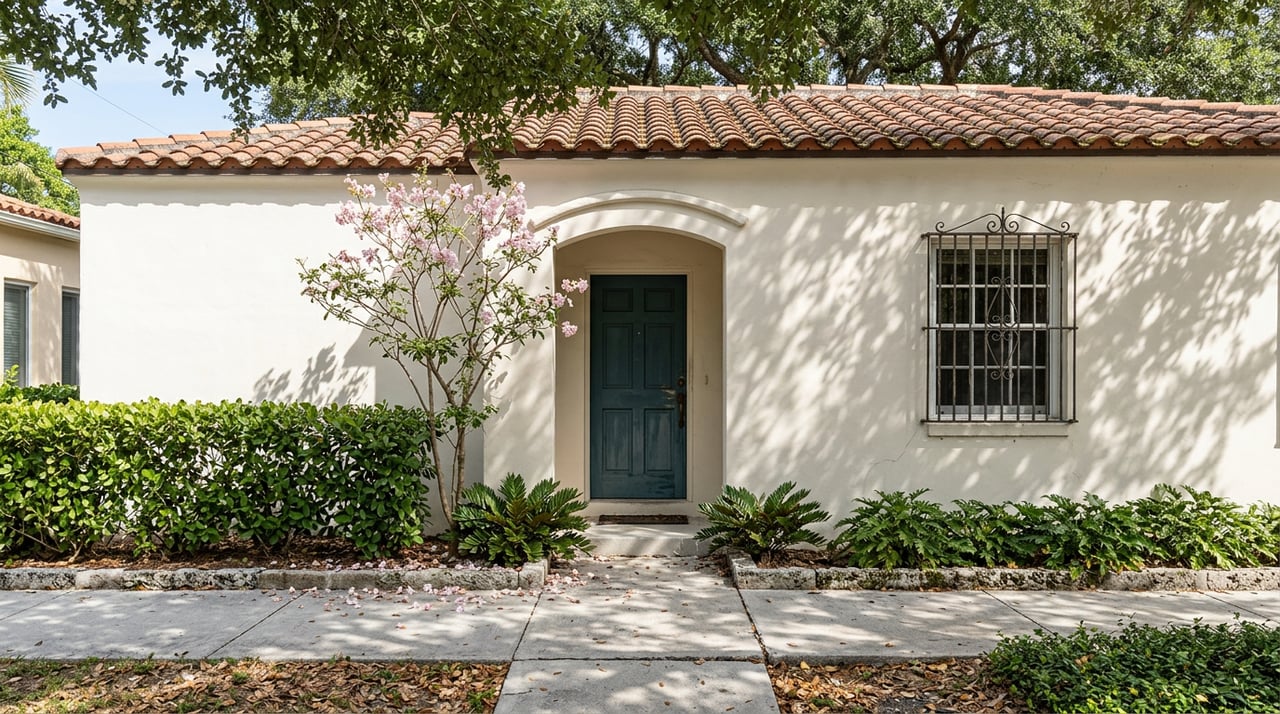
Walk two blocks west from the glass towers of Brickell and the street under your feet stops behaving. It bends without warning. The house numbers jump in a way that makes no sense if you learned Miami on the standard grid. Delivery drivers circle twice before finding the turn. None of that is an accident, and none of it is a flaw. It is the entire reason The Roads still feels like a neighborhood instead of a cut-through, even with a financial district growing taller a few blocks away every year.
The turn nobody warns you about
Mary Brickell platted this triangular pocket, then called Brickell Hammock, in January 1922, days before her death. She designed it as a pedestrian-first neighborhood with wide streets, median parkways, and roundabouts planted with native species, then gave the streets, sidewalks, and electric lighting to the City of Miami that same year. Every lot sold in a single day, February 1, 1923.
That history explains the charm. It does not explain why the streets still feel calm a century later, and this is the part most guides skip. South of Southwest 11th Street, the roads run northwest to southeast and the avenues run northeast to southwest, roughly 45 degrees off the rest of the county's grid. A Miami-Dade Metropolitan Planning Organization report on the neighborhood documents the effect at the western edge, where historic Coral Way makes a 45-degree turn and becomes Coral Way and Southwest 22nd Street as it meets Southwest 12th Avenue. Numbering jumps in ways that trip up first-time visitors and GPS routing alike.
The same report offers the plainest explanation for why this still matters to anyone living here today:
A benefit of this confusion is that motorists are less likely to take shortcuts.
That's the mechanism. The Roads sits directly between Brickell's financial core and the Vizcaya Metrorail corridor, prime real estate for cut-through traffic in most Miami neighborhoods this close to downtown. Instead, the street plan itself discourages it. The quiet isn't a byproduct of low density or luck. It's built into the plat.
Two parks, one hammock, and a rule people learn the hard way
The neighborhood's green space splits into two very different experiences, and knowing which is which saves a trip.
Simpson Park Hammock sits right on the seam between Brickell and The Roads at 55 Southwest 17th Road. Its 7.8 acres are one of the last surviving fragments of the original Brickell Hammock, a tropical hardwood forest that once ran unbroken from the Miami River to Coconut Grove. Part of the park is recognized as old growth by the Old-Growth Forest Network. It started life as Jungle Park in 1913, when a group of local conservationists set aside 5.5 acres to save it from clearing, and was renamed in 1927 for botanist Charles Torrey Simpson. A half-mile network of crushed shell paths loops past a koi pond and a paradise tree recognized as a national champion, the largest known specimen of its species in the country, according to Florida Hikes. The garden club building that now doubles as a visitor center went up in 1941.
None of that comes with a dog. Simpson Park does not allow pets, and the gate closes at 3 p.m. daily. Residents who default to it out of proximity, since it's the closest patch of green to much of the neighborhood, sometimes find that out the hard way on a Saturday afternoon walk.
Alice Wainwright Park, along Brickell Avenue at the bay, is the opposite kind of park: dog-friendly, waterfront, built for actual recreation with a jogging path, playground, workout equipment, and picnic pavilions. It's also mid-construction right now. The City of Miami is in Phase II of its Seawall and Baywalk Improvements project there, covering bathroom and office building upgrades including plumbing, electrical, and mechanical work. Phase I, finished in December 2021, replaced the aging seawall and added roughly 33,000 square feet of baywalk built from pervious, compacted aggregate designed to let rainwater drain through rather than pool.
| Park | Pets | What's true right now |
|---|---|---|
| Simpson Park Hammock | Not allowed | Full hammock trail open, gate closes at 3 p.m. daily |
| Alice Wainwright Park | Allowed | Phase II construction ongoing: restroom and office building upgrades |
The trolley stop hiding in the hammock's shade
Simpson Park does double duty as a transit hub most residents never think to use. The free Coral Way Trolley, run by the City of Miami, stops directly at Simpson Park on its route between Government Center, Brickell Village, the Financial District, Shenandoah Park, and Miracle Mile. The same trolley also connects onward to Metrorail and Metromover, and it's the only public transit line with a direct stop at PortMiami.
For a resident of The Roads, that means a walk under the hammock canopy connects, for free, to the entire downtown rail network without moving a car out of the driveway. The trolley runs Monday through Saturday from 6:30 a.m. to 11 p.m. and Sundays from 8 a.m. to 8 p.m. It's the same route tourists ride to the cruise terminals, but for someone who lives four blocks away, it functions less like a sightseeing loop and more like a second driveway.
What actually fills a Saturday on the ground
Inside the triangle itself, Triangle Park is the neighborhood's own pocket green space, with a basketball court, picnic tables, and a playground, the closest thing to a proper local hangout before crossing toward the bay.
Food and errands cluster along the neighborhood's edges. Tutto Pasta and its coffee counter, Tutto Caffè, cover both a sit-down lunch and a fast espresso. Honey Uninhibited handles the plant-forward crowd. For dessert, Rivero Gelato and Cakeology by Erica are the two names locals actually repeat. Galeria Adelmo, a small gallery space, promotes local artists and hosts painting classes and private studio sessions for anyone looking for something other than a restaurant on a Saturday afternoon. For the ordinary errand run, Farm Stores Brickell handles the drive-thru grocery and bakery stop, and Oriental Bakery & Grocery covers specialty pantry items harder to find elsewhere in the neighborhood.
One name from the old lineup is missing now. Perricone's Marketplace & Café opened in Brickell in 1996 and moved to a new spot on the edge of The Roads after its original Brickell property sold to a hotel developer in 2018. It closed for good in May 2024 after nearly three decades in business, according to Miami New Times. The kitchen team resurfaced months later as Pecorino's, a ghost-kitchen version of the same menu now delivering out of Edgewater, per Lifestyle Media Group. Even a neighborhood built on a century-old plat and streets designed to slow traffic down still turns over its storefronts. The building it left behind is a quiet reminder of that.
For anyone drawn to the water, Biscayne Bay is close enough to reach without owning a boat. LUXE Charters books day trips and private events on the water, and Gone Fishing runs charters with Captain Jack, who has fished South Florida waters since childhood and takes guests after what local anglers call the Super Grand Slam: tarpon, permit, bonefish, and snook.
The version that actually fits in a morning
For anyone short on time, the shape of a good Saturday here looks something like this:
- Walk the crushed shell loop at Simpson Park Hammock before the 3 p.m. gate closing, and leave the dog at home.
- Catch the free Coral Way Trolley from the Simpson Park stop and ride it toward Brickell Village or all the way to PortMiami, no car required.
- Circle back for coffee at Tutto Caffè.
- Head to Alice Wainwright Park instead of Simpson Park for the dog walk, since it's the one that actually allows pets.
- If the bay is calling, book a half day with LUXE Charters or Gone Fishing and let someone else handle the boat.
None of this works as well anywhere else nearby, and that's the point. Brickell's density and Coconut Grove's canopy both sit within a mile, but the reason this particular triangle still moves at its own pace traces back to a decision made in 1922: build the streets at an angle, and the traffic that would otherwise cut through simply won't bother.
Whether you've watched this neighborhood change for twenty years or you're just getting to know its diagonal streets, Alex Miranda Group at ONE | Sotheby's International Realty knows The Roads down to the roundabouts. If a move within Miami is somewhere on your horizon, we'd welcome the chance to talk through what that could look like. Schedule a consultation whenever you're ready.